_v1.png)

Categories
Home Selling, Success StoriesEDMOND SELLER CASE STUDY | SILVERHAWK
Edmond Seller Case Study: What to Do When Your Home Gets Showings but Isn't Selling
What should an Edmond seller do when buyers like the house, but the original asking price isn't producing an acceptable offer?
That's exactly the situation we faced with a recent listing I represented at 2433 NW 173rd Street in Edmond's Silverhawk neighborhood.
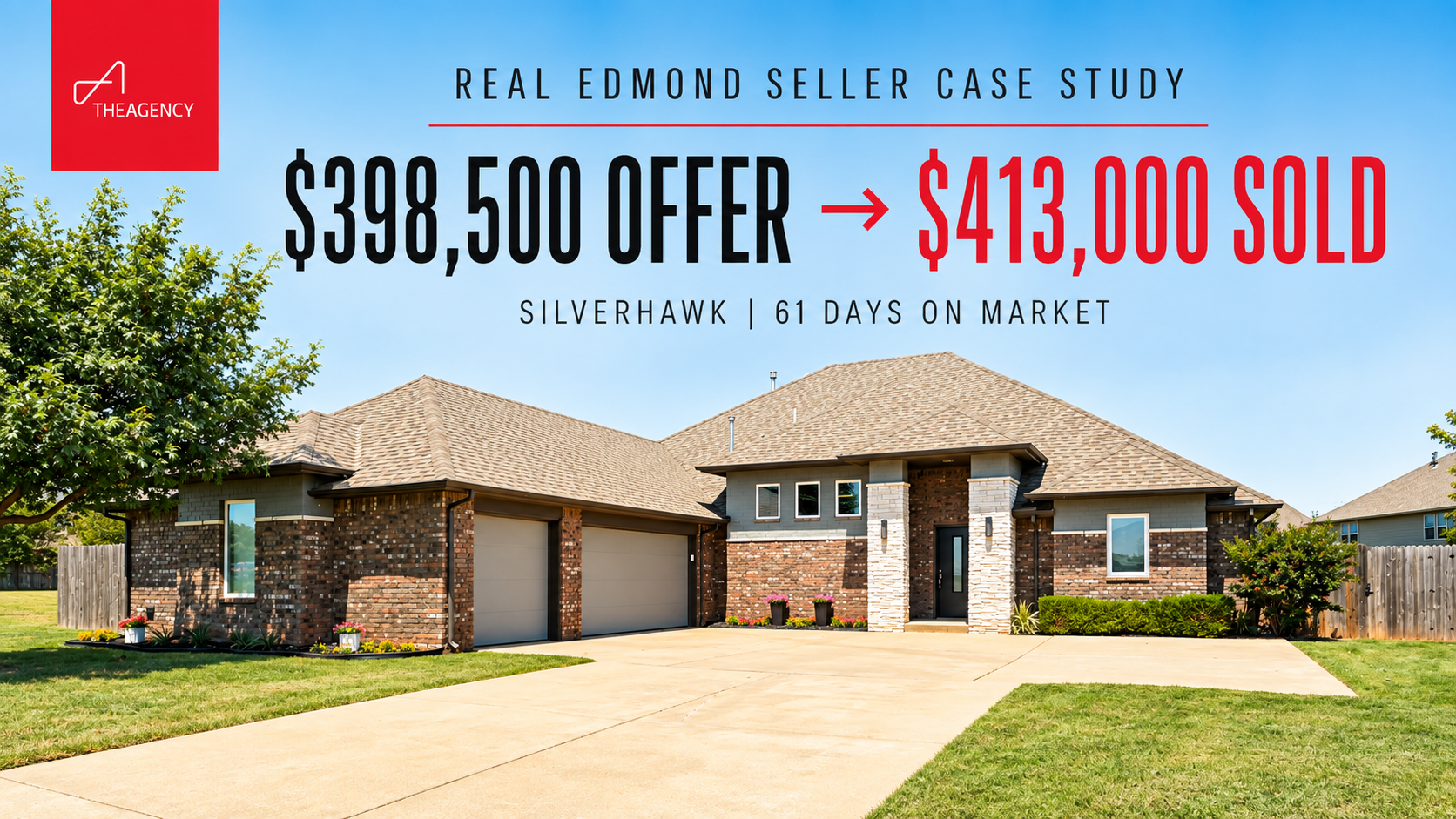
We listed the home at $425,000. Over 61 days, it generated 21 showing appointments, generally positive buyer feedback, multiple offers with very different terms, and eventually an initial $398,500 offer from the buyer who ultimately purchased the property.
Rather than simply accepting or rejecting that offer, we used what the previous 60 days had taught us about the market and negotiated the buyer to $413,000, with $5,000 in seller concessions.
Then an independent structural engineer identified a repair issue during the inspection period, creating another decision for the seller: address the significant repairs and preserve the transaction, or return to the market after more than 60 days with newly documented information about the property.
The home closed September 30, 2026, for $413,000.
The important part of this case study isn't that everything went according to plan. It didn't.
A seller and listing agent can study the comparable sales, prepare the property, build a sound launch strategy and still not perfectly predict when the right buyer will enter the market or exactly how buyers will respond.
A strong listing strategy still matters. But so does what happens when the original plan doesn't produce the result you hoped for.
This sale became a case study in recognizing what the market was telling us, adjusting without panicking, negotiating from the information we had, and continuing to solve problems until we reached the closing table.
Why Was This Edmond Home Difficult to Price?
2433 NW 173rd wasn't a house that fit neatly into a price-per-square-foot formula.
The 2,546-square-foot Jeff Click-built home had modern architecture and several features that differentiated it from many nearby properties:
- Approximately half-acre lot
- 3.5-car garage
- Large plaza-style driveway
- Two oversized covered patios
- Media/flex room
- Elevated loft-style office
- Adjacent common/green space
- Neighborhood walking trails directly across the street
Those differences mattered because comparable sales tell us what buyers have paid for other homes. They don't automatically tell us exactly how much today's buyer will pay for a larger lot, another garage bay, a different architectural style or better outdoor living.
My initial pricing recommendation was around $410,000. The seller wanted to test closer to $430,000.
There was evidence supporting an aggressive test. One particularly relevant Silverhawk sale with a mirrored version of the floor plan had closed at $424,000. Another nearby property had sold for $415,000, although that transaction included $12,000 in concessions.
Our home also had meaningful advantages over those properties, particularly its lot, garage capacity, driveway and outdoor living space.
We ultimately listed at $425,000.
Should a seller ever list higher than the agent's initial pricing recommendation?
Sometimes, if the higher price is still defensible and everyone agrees to watch the market response closely. In this case, I was comfortable testing the upper end because comparable sales and the property's unique features gave us a reasonable basis for doing it. The important part was treating $425,000 as a pricing strategy to test, not a number we had to defend indefinitely.
Should You Lower the Price if Buyers Like Your Edmond Home but Aren't Making Offers?
This listing demonstrated an important distinction between property feedback and price feedback.
Over the course of the listing, we had 21 showing appointments. The feedback we received about the house itself was generally positive. Several agents reported that their buyers were highly impressed with the property.
But positive feedback wasn't consistently turning into acceptable offers.
That told me we weren't primarily dealing with a presentation problem. If buyers had consistently disliked the condition, layout or presentation, we might have needed to change staging, make improvements or rethink the marketing.
Instead, buyers generally liked what they saw but weren't consistently accepting the value proposition at $425,000.
That's a price-to-value conversion problem.
Does positive showing feedback mean your home is priced correctly?
No. Buyers can genuinely like a home and still decide they don't like it enough at the current price. That's why I evaluate showing volume, buyer feedback, repeat interest, offers and competing sales together rather than relying on compliments from showings.
Is a Full-Price Offer Always the Best Offer for an Edmond Home Seller?
No, and we had a real example during this listing.
Our first written offer arrived early at $400,000 and requested $15,000 in seller-paid buyer costs, along with other transaction costs requested from the seller.
The seller wasn't under pressure to accept those economics that early in the listing, so he declined.
Later, however, we received something that sounds much better on paper: a full-price $425,000 offer.
But the price was only part of the offer.
The buyers' purchase was contingent upon selling another property, and they also wanted to occupy this home before closing.
I recommended that the seller evaluate the probability and consequences of actually reaching closing, not simply the number at the top of the contract.
We were not comfortable allowing the buyers to occupy the property before closing, and I also wanted stronger assurances regarding their financing.
That transaction ultimately did not become the sale.
Is a full-price contingent offer always better than a lower offer with cleaner terms?
No. The best economic outcome for a seller depends on more than price. Financing, contingencies, seller-paid costs, possession, timing and the probability of reaching closing all affect the real value and risk of an offer.
Should a Seller Let a Buyer Move In Before Closing?
One of the terms in that full-price offer was a request for the buyers to rent and occupy the Silverhawk home before the transaction actually closed.
I recommended against it.
Pre-closing occupancy can create an entirely different set of problems for a seller if financing is delayed or the transaction fails to close. Instead of simply dealing with a failed real estate contract, the seller may also be dealing with occupants already living in the property.
For this seller, I didn't believe the additional risk was justified simply to preserve the full-price contract.
Should an Edmond seller agree to pre-closing buyer occupancy to save a deal?
It depends on the circumstances, but I advised against it in this transaction. The seller still owned the property until closing, and the requested early occupancy introduced additional risk that wasn't necessary for us to accept.
When Should an Edmond Seller Change the Original Pricing Strategy?
As our days on market accumulated, we had something increasingly valuable: more information than we had on listing day.
We knew how many buyers had toured the property. We knew what they liked. We knew what they hadn't been willing to pay. We had actual offers to analyze.
We also had newer competitive information.
A relevant 2,727-square-foot Silverhawk property on Shadow Hawk had started at $435,000, reduced to $420,000 and went pending after 32 days.
It wasn't identical to our listing, but it provided another useful indication of where buyers were engaging with the neighborhood market.
None of this meant the original $425,000 strategy had been irrational. It meant we now had better information than we possessed when we chose it.
Does changing your pricing strategy mean the original list price was wrong?
Not necessarily. Pricing decisions are made with the best available information at a particular moment. Once a home is exposed to the market, actual buyer behavior becomes another important source of evidence. A good listing strategy should incorporate that new information rather than ignore it.
What if Your Home Doesn't Sell the Way You Expected After Listing It?
Sometimes a listing simply doesn't hit the market the way the seller and agent expected.
That doesn't automatically mean the home was poorly marketed or that the original strategy had no basis. We can study recent sales, evaluate the competition, prepare the property and make a well-supported pricing decision, but neither the seller nor the listing agent can perfectly control which buyers will be in the market during a particular few weeks or exactly how those buyers will respond.
That's one reason I think sellers should evaluate a listing agent on more than the plan presented before the home goes on the market.
The launch matters. But so does the ability to recognize when the market isn't responding as expected and determine what should happen next.
With this Silverhawk home, the evidence changed over time. We had positive showing feedback but not enough conversion. We saw competing properties make adjustments. We received multiple offers with very different economics and risks. Eventually, we had a buyer at the table whose initial $398,500 offer was well below where we had started.
At that point, continuing to defend $425,000 simply because it had been our original list price wouldn't have served the seller.
Neither would immediately accepting $398,500 simply because the listing had reached roughly two months on the market.
We adjusted to the information we had and negotiated.
What should you expect from your listing agent if the original strategy isn't working?
You should expect your agent to recognize what the market is telling you, explain the tradeoffs honestly and recommend a specific next move. Sometimes that means holding firm. Sometimes it means adjusting price or terms. Sometimes it means negotiating an offer that initially appears too low. The goal shouldn't be to prove the original strategy was right. It should be to make the best decision available to the seller with the information the market is giving us now.
What Should You Do With a Low Offer After Your House Has Been Listed for 60 Days?
At approximately the two-month mark, another buyer submitted an initial offer of $398,500 and requested $5,000 in seller-paid closing costs.
Compared with our original $425,000 asking price, it would have been easy to dismiss the offer immediately.
But after approximately 60 days on the market, we knew considerably more than we did when we listed the house.
Simply rejecting $398,500 because it was $26,500 below our original asking price would have ignored that information.
Simply accepting it would have been unnecessary too.
My recommendation was to negotiate.
We used what the market had shown us to push the buyer substantially higher while still putting together terms that could work for both sides.
The result was a $413,000 contract with $5,000 in seller concessions.
That's $14,500 above the buyer's initial offer price.
Should you reject a low offer on your Edmond home?
Not just because the first number is low. An offer is also an opportunity to negotiate. In this case, the eventual buyer started at $398,500 and we negotiated the price to $413,000. Whether a seller should counter, accept or reject depends on the offer terms and what the market has already told us about the property.
How Much Do Seller Concessions Matter When Evaluating an Offer?
The final contract included $5,000 in seller concessions.
That matters when evaluating the economics of the sale.
A $413,000 offer with $5,000 in seller-paid costs is financially different from a $413,000 offer without them. The same principle applied to our earlier $400,000 offer that requested $15,000 in seller-paid buyer costs.
This is why I don't advise sellers to compare offers using purchase price alone.
Should an Edmond seller accept an offer asking for closing-cost assistance?
Seller concessions aren't automatically good or bad. They are one part of the offer's economics. I look at the price, requested concessions and the rest of the contract together to determine what the seller is actually being offered.
What Happens if an Inspection Finds a Foundation Problem After You're Under Contract?
Getting to $413,000 didn't end the negotiation.
Before the final contract was accepted, I had already communicated to the buyer's side that the seller had moved substantially during the price negotiations and would have very little additional room for discretionary repair requests.
The subsequent inspections identified several concerns, including failed windows, a sprinkler leak and cracking near the garage.
The crack was the potentially significant issue.
Rather than assuming that a visible crack automatically meant the house had a foundation problem, the buyers obtained an evaluation from an independent structural engineer.
The engineer ultimately recommended structural repairs.
At that point, we had new information that couldn't simply be ignored.
Should a seller get an independent structural opinion when foundation concerns arise?
In this transaction, having an independent engineer evaluate the concern gave both sides better information for the negotiation. We were able to make decisions based on a professional structural assessment rather than trying to determine the significance of a crack from appearance alone.
Should You Cancel a Contract and Relist if an Inspection Finds Foundation Problems?
This was one of the most important decisions in the entire transaction.
The seller had already moved from the original asking price. Understandably, he wasn't eager to spend thousands more after reaching an agreement with the buyer.
But the right question wasn't simply:
"Why should I have to pay for this too?"
Once the engineer had documented the issue, terminating the contract wouldn't make the underlying condition disappear.
We would potentially be returning to the market after more than 60 days with new information about the property, while facing the possibility that another buyer could raise the same issue.
So I encouraged the seller to look at the decision economically:
What is the cost of solving the significant problem compared with the financial risk of losing this transaction and starting over?
Those are not always the same number.
Is it sometimes better to make a major repair rather than put the house back on the market?
Yes, depending on the numbers and circumstances. In this case, we had a $413,000 contract after more than 60 days on the market and an engineer had now recommended structural repairs. We had to compare the repair cost with the uncertainty and potential cost of losing the existing buyer and remarketing the property.
Does a Seller Have to Agree to Every Repair a Buyer Requests?
No, and we didn't.
The inspection-related items under discussion included approximately:
- More than $3,000 in recommended structural work
- $1,335 for failed windows
- Approximately $900 for the sprinkler issue
My recommendation wasn't for the seller to simply agree to everything because we wanted to preserve the transaction.
Instead, we worked through which issues were significant enough to address and where the seller could reasonably hold the line.
The final resolution was that the seller completed the recommended structural work and the window repairs.
The seller did not take responsibility for the sprinkler repair.
Can you negotiate which inspection repairs a seller will complete?
Yes. Inspection negotiations don't have to be all-or-nothing. In this transaction, the seller addressed the structural work and failed windows but did not agree to the sprinkler repair. The goal was to address the issues most important to preserving the transaction without turning the inspection period into an unlimited second negotiation.
Silverhawk Seller Case Study: The Final Numbers
Property: 2433 NW 173rd Street, Edmond, OK 73012
Neighborhood: Silverhawk
Original List Price: $425,000
Eventual Buyer's Initial Offer: $398,500
Final Sale Price: $413,000
Increase From Buyer's Initial Offer: $14,500
Sale-to-List Price: 97.2%
Seller Concessions: $5,000
Days on Market: 61
Closing Date: September 30, 2026
The property sold for $12,000 below its original asking price, approximately 97.2% of list price.
But that's not the number I think matters most.
The seller had to make a series of decisions as the information changed:
- How aggressively should we price a distinctive property?
- What did positive showings without enough offers tell us?
- Was a full-price offer still attractive when we considered its contingencies and occupancy request?
- How should we respond when the eventual buyer opened at $398,500?
- How much negotiating room remained after reaching $413,000?
- What should we do when an engineer subsequently recommended structural repairs?
- Which inspection items were worth addressing to preserve the transaction?
Those decisions, more than any single list-to-sale percentage, are what seller representation actually looks like.
What Can Other Edmond Home Sellers Learn From This Sale?
The biggest lesson from 2433 NW 173rd isn't that every decision worked exactly as we hoped.
It didn't.
We launched at $425,000 and ultimately sold at $413,000 with $5,000 in seller concessions. That wasn't the outcome we were aiming for when the property first went on the market.
But sellers and agents don't get to control the market. We can study it, prepare for it and make informed decisions based on it, but we can't perfectly time when the right buyer will appear or dictate what that buyer will be willing to pay.
What we can control is how we respond when the market gives us new information.
In this case, that meant recognizing the difference between buyers disliking the house and buyers resisting the price.
It meant evaluating a full-price offer based on its risks rather than its headline number.
It meant taking a $398,500 offer seriously without accepting it, and negotiating that buyer to $413,000.
And when an engineer later recommended structural repairs, it meant evaluating the cost of solving the problem against the risk of losing the transaction and starting over.
That's why I believe sellers should expect more from their listing agent than a good launch.
A good listing agent should also have the ability to adjust when the original plan isn't producing the expected result, negotiate effectively when an opportunity appears, and keep solving problems as the transaction changes.
Sometimes the best result available today isn't the result everyone hoped for on listing day. The job is to recognize that honestly, protect the seller's leverage where it still exists, and make the best decision available with the information we have.
Thinking About Selling a Home in Edmond, Oklahoma?
If you're considering selling a home in Edmond, Deer Creek or North Oklahoma City, I can help you evaluate your property's likely buyer pool, comparable sales, current competition and the tradeoffs involved in different pricing strategies.
You can start with my complete guide to selling a home in Edmond, Oklahoma, or request a home value and pricing analysis.
If you're still deciding when or how to sell, you may also find my step-by-step Edmond home selling guide useful.