
Categories
Home SellingUpdated September 2026
If you're thinking about selling your home in Edmond, you probably understand the basic idea:
Prepare the house. List it. Find a buyer. Close.
But once you actually start planning a move, the questions get more specific.
What should you fix before listing? How is the price determined? When do photos happen? What happens during showings? How do you evaluate an offer? What happens after the inspection? What if the appraisal comes in low? And when do you actually get your money?
This guide walks through the Edmond home selling process from the first conversation through closing.
I'm Ryan Hukill, a listing-focused Real Estate Advisor with The Agency Oklahoma. I've worked in residential real estate since 2002, and my listing practice today focuses primarily on homeowners in Edmond, Deer Creek, and north Oklahoma City.
The exact process varies from property to property, but a well-managed sale generally follows the same basic sequence.
Thinking About Selling Your Edmond Home?
You don't have to wait until you're ready to put a sign in the yard.
I can look at your home, current competition, likely value, preparation needs, and timeline and show you what the selling process would look like for your specific situation.
The earlier we plan, the more options you usually have.
Get My Edmond Home Value & Selling Analysis | Call or Text Ryan: 405-477-1881
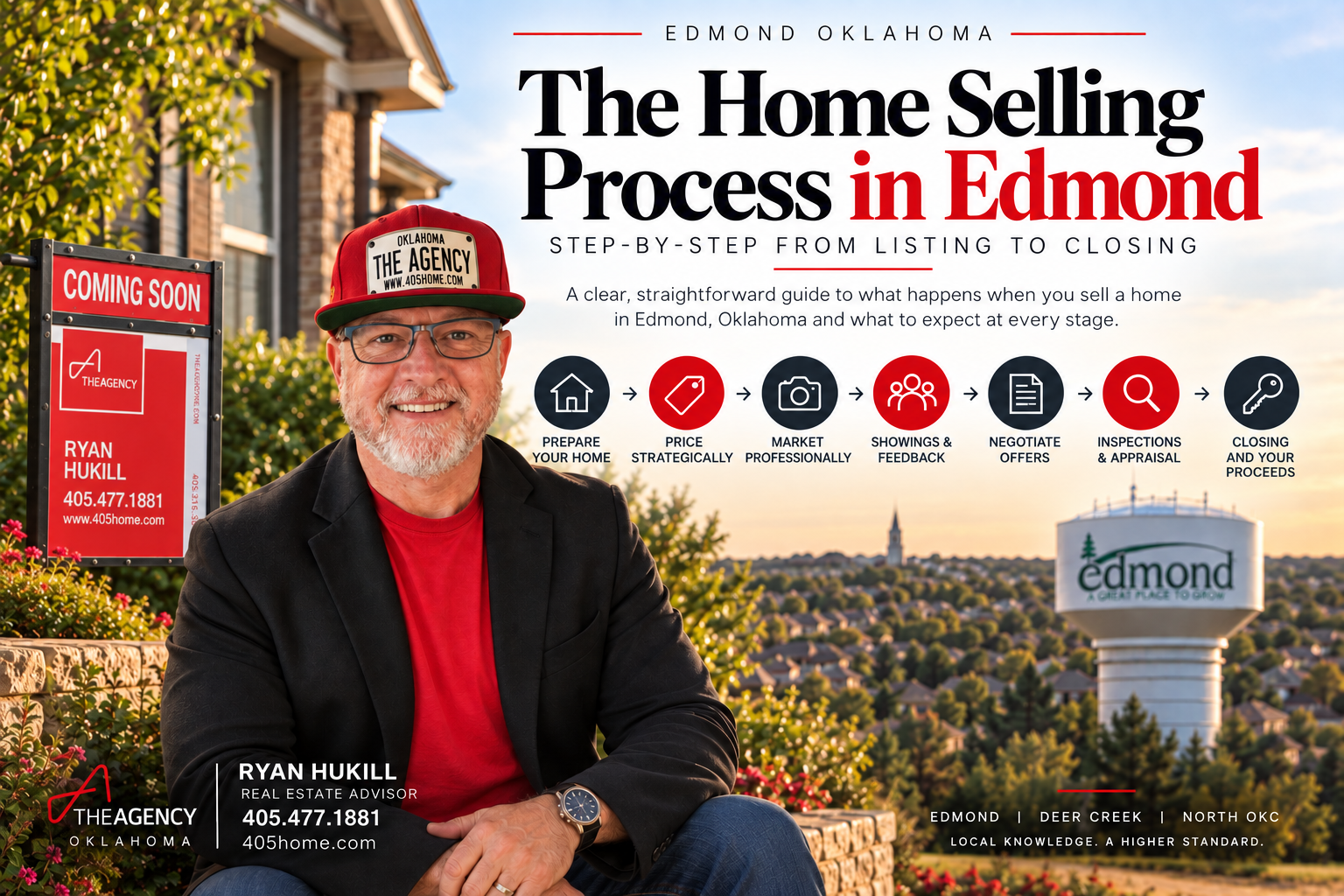
Edmond Home Selling Process at a Glance
- Determine your goals and timeline
- Evaluate your home's market value
- Study current competition
- Prepare the property for sale
- Develop the pricing strategy
- Create professional marketing
- Launch the listing
- Manage showings and buyer feedback
- Evaluate and negotiate offers
- Navigate inspections and repair negotiations
- Complete appraisal, title and buyer financing
- Prepare for closing and possession
- Close the sale and receive your proceeds
That list makes the process look linear.
In reality, several of those steps overlap, and the decisions made early in the process can affect what happens much later.
Here's what each stage actually looks like.
Step 1: Define Your Goals Before Talking About Price
Before deciding what your home is worth, I want to understand why you're selling.
That isn't small talk. It affects the strategy.
For example:
- Are you relocating?
- Moving up?
- Downsizing?
- Building another home?
- Trying to sell before buying?
- Buying before selling?
- Working around a school calendar?
- Trying to maximize price regardless of timeline?
- Working with a firm deadline?
A seller who needs to close within 45 days may need a different strategy than someone who can wait several months for the right buyer.
The best selling strategy starts with the seller's objective, not the MLS.
Step 2: Determine What Your Edmond Home Could Realistically Sell For
Next, we establish a realistic market-value range.
This is not the same thing as looking at an automated home-value estimate.
I evaluate factors such as:
- Recent comparable sales
- Pending sales
- Current competing listings
- Price reductions
- Expired or withdrawn listings
- Neighborhood
- Square footage
- Lot
- Floor plan
- Updates
- Property condition
- Age of major systems
- Buyer demand in the price range
One of the most important distinctions is between historical value and current competition.
Closed sales tell us what buyers previously paid.
Active listings tell us what today's buyer can choose instead of your house.
We need both.
Start here if you're still trying to understand your likely value: What Is My Home Worth in Edmond Oklahoma?
Step 3: Identify Your Real Competition
Your competition isn't every home for sale in Edmond.
It's the group of properties a likely buyer will compare against yours.
That might mean homes:
- Within the same neighborhood
- Within a similar school area
- Within the same price bracket
- With similar square footage
- With comparable bedrooms and bathrooms
- With similar amenities
- With similar age and condition
This matters because buyers don't evaluate your home in isolation.
If your home is listed at $600,000, the buyer is effectively asking:
“Is this the best house I can buy around $600,000?”
That's the comparison we need to win.
Step 4: Decide What to Fix Before Listing
This is where sellers can either make smart investments or waste a lot of money.
You generally do not need to remodel your entire house before selling.
The objective is to identify improvements that:
- Reduce buyer objections
- Improve first impressions
- Make the home photograph better
- Increase buyer confidence
- Improve perceived value
Depending on the property, that might include:
- Paint touch-ups
- Minor repairs
- Lighting changes
- Decluttering
- Deep cleaning
- Landscaping
- Carpet replacement or cleaning
- Staging
- Addressing obvious deferred maintenance
It might not mean a new kitchen, new bathrooms, or tens of thousands of dollars in remodeling.
Related guides:
- How to Prepare Your Edmond Home Before Listing
- What Not to Waste Money on Before Selling Your Edmond Home
- How to Sell Your Edmond Home Without Doing a Full Remodel
Step 5: Build the Pricing Strategy
Once we understand the property, preparation, competition, and seller's goals, we can determine the launch price.
Price isn't just a valuation decision.
It's a marketing decision.
Your list price affects:
- Which buyers find the property
- Which search brackets include it
- How it compares with competing homes
- Whether buyers perceive value
- How much showing activity you receive
- Your negotiating leverage
I don't believe the goal should automatically be to list as high as possible.
Nor should the goal automatically be to price low simply to generate a quick sale.
The goal is to choose a price that gives us the strongest reasonable opportunity to maximize your overall result.
Read: How to Price Your Edmond Home in 2026 Without Leaving Money on the Table.
Step 6: Prepare the Marketing Before the Listing Goes Live
Marketing should be ready before buyers can see the listing.
Depending on the property, that may include:
- Professional photography
- Professional video
- Drone photography or video where appropriate
- Floor-plan or property-feature information
- MLS copy
- Social media content
- Email marketing
- Database exposure
- Agent-to-agent promotion
- Neighborhood marketing
- Digital advertising
Your first showing usually happens on a phone.
Before buyers schedule an appointment, they're already deciding whether the property looks worth seeing.
We need the home to win that decision.
Step 7: Launch the Home
The first several days on market are disproportionately important.
That's when your listing is new.
Buyers who have been watching the market receive alerts. Agents notice new inventory. People who haven't found the right house yet suddenly have something new to consider.
That's why I don't like casually putting a property into the MLS and then figuring out the marketing afterward.
We should be completely ready before the starting gun goes off.
The goal is to create as much qualified attention as possible while the property still has the psychological advantage of being new.
Step 8: Manage Showings and Buyer Feedback
Once buyers start touring the home, we begin receiving real market evidence.
I pay attention to:
- Showing volume
- Showing feedback
- Repeat showings
- Questions from agents
- Online activity
- Competing listings
- New listings entering the market
- Price changes around us
- Offers
This is where one of my core listing guidelines comes in:
10 days or 10 showings.
By then, the market has usually told us something useful.
Strong showing activity with no offers means something different from almost no showing activity.
We diagnose before reacting.
But if the evidence tells us the positioning isn't working, I don't want to ignore it until the listing becomes stale.
Step 9: Evaluate and Negotiate Offers
When an offer arrives, price is only one part of the equation.
We also need to evaluate:
- Financing type
- Down payment
- Preapproval strength
- Earnest money
- Requested seller concessions
- Inspection terms
- Appraisal risk
- Contingencies
- Closing date
- Possession
- Overall likelihood of closing
A $600,000 offer is not necessarily better than a $595,000 offer if the higher offer carries significantly more risk or concessions.
The goal is the strongest overall contract, not simply the largest number printed at the top.
Step 10: Go Under Contract
Once both sides agree to the contract, your home is under contract.
This is a major milestone.
It is not the finish line.
Several things still have to happen before the transaction closes.
Depending on the contract, those may include inspections, repair negotiations, appraisal, title work, financing, insurance, and final lender approval.
Step 11: Navigate the Inspection Period
The buyer will typically conduct a general home inspection and may order additional inspections depending on the property.
The buyer may then request:
- Repairs
- Credits
- Price adjustments
- Other concessions
This is another negotiation.
Sellers don't automatically have to agree to everything a buyer requests.
The correct response depends on:
- The seriousness of the issue
- Contract terms
- Market conditions
- How strong the buyer is
- Whether backup interest exists
- The cost and risk of returning to market
Read: How to Handle Inspection Requests When Selling Your Edmond Home.
Step 12: Complete the Appraisal
If the buyer is financing the purchase, the lender will usually order an appraisal.
The appraiser provides an independent opinion of value for the lender.
If the appraisal supports the contract price, the transaction generally continues through financing.
If it comes in low, the next steps depend heavily on the contract.
Possible outcomes may include:
- The buyer bringing additional cash
- The seller adjusting the price
- The parties negotiating a compromise
- Challenging the appraisal when there is legitimate supporting evidence
- Other remedies available under the contract
This is one reason pricing and comparable-sale analysis matter even after you receive an offer.
Step 13: Title, Financing and Final Loan Approval
While inspections and appraisal are happening, other parts of the transaction are moving behind the scenes.
The title company works through title requirements and prepares for closing.
The buyer's lender continues underwriting and verifies the buyer's:
- Income
- Assets
- Credit
- Employment
- Insurance
- Other loan requirements
Eventually the lender issues final approval to close once its requirements have been satisfied.
Step 14: Prepare for the Final Walkthrough
Shortly before closing, the buyer will typically conduct a final walkthrough.
The purpose isn't to renegotiate the house from scratch.
It's generally to verify that:
- The property remains in the expected condition
- Agreed repairs have been completed
- Included items remain with the property
- No major new issue has developed
By this point, the seller should also be preparing for possession according to the contract.
Step 15: Closing Day
At closing, you'll sign the documents necessary to transfer ownership.
The title company handles the settlement process, including the final accounting of the transaction.
Your final settlement statement will reflect items such as:
- Sale price
- Mortgage payoff
- Taxes and prorations
- Agreed seller expenses
- Closing costs
- Commissions
- Other contract-specific charges or credits
Once the transaction has funded and closed, your net proceeds are disbursed according to the closing instructions.
How Long Does the Entire Edmond Home Selling Process Take?
There isn't one reliable number because there are multiple phases.
A seller may spend:
- Several days to several weeks preparing the property
- Days or weeks actively on the market before accepting an offer
- Several additional weeks under contract before closing
As of August 2026, Realtor.com reported a median of 56 days on market in Edmond. That is only the active-market portion and does not include preparation before listing or the entire contract-to-closing period.
Your individual timeline can be substantially shorter or longer depending on price, neighborhood, condition, competition, financing, and strategy.
For the full timeline breakdown, read: How Long Does It Take to Sell a Home in Edmond Oklahoma?
What Does It Cost to Sell a Home in Edmond?
Seller expenses vary by transaction.
Potential costs may include:
- Pre-listing preparation
- Repairs
- Real estate commissions
- Title-related charges
- Taxes and prorations
- Mortgage payoff expenses
- Buyer concessions negotiated in the contract
- Inspection-related repairs or credits
- Other transaction-specific expenses
The useful number isn't simply the sales price.
It's what you expect to walk away with after the sale.
Read: What Closing Costs Do Sellers Pay in Edmond Oklahoma?
What Are the Biggest Mistakes Edmond Sellers Make During the Process?
The mistakes I see most often tend to happen early:
- Starting too high on price
- Spending money on the wrong improvements
- Going live before the home is completely ready
- Using weak photography or marketing
- Ignoring current competition
- Making showings unnecessarily difficult
- Ignoring early buyer feedback
- Focusing only on offer price instead of contract strength
- Giving away too much during inspection negotiations
- Waiting too long to react when the market sends a clear signal
Most of those are avoidable with planning.
Do You Need to Buy Your Next Home Before Selling?
Not necessarily.
Some Edmond homeowners sell first. Others buy first. Some attempt to coordinate both transactions.
The right approach depends on:
- Your financial flexibility
- Your current equity
- The competitiveness of the home you're trying to buy
- How quickly your current home is likely to sell
- Your tolerance for carrying two homes
- Your tolerance for temporary housing
This should be part of the strategy before your home goes on the market.
What If Your Edmond Home Doesn't Sell?
A listing that isn't selling is giving us information.
The question is what that information means.
Possible causes include:
- Price
- Condition
- Presentation
- Competition
- Location
- Floor plan
- Marketing
- Showing accessibility
- Buyer demand
Some factors can be changed. Others need to be accounted for in the price.
If the listing has already become stale, the solution isn't always another small price reduction.
Sometimes the entire positioning needs to be reset.
Read: How Edmond Sellers Can Relaunch a Stale Listing.
How I Approach the Edmond Home Selling Process
I don't think a seller should feel like their home was simply entered into a system and left there.
My process is built around five things:
- Preparation before buyers see the property
- Evidence-based pricing rather than telling the seller the number they want to hear
- Professional positioning and marketing
- Fast evaluation of buyer response
- Negotiation through every stage of the transaction
And once we're on the market, I come back to the same principle:
10 days or 10 showings.
We don't panic because a house hasn't sold immediately.
But we also don't ignore evidence.
The market will tell us how buyers perceive the property. Our job is to listen, diagnose correctly, and respond strategically.
Want to Know What This Process Would Look Like for Your Home?
I'll walk through your specific situation with you.
We'll look at:
- What your Edmond home could realistically sell for
- What you're competing against
- What I would prepare before listing
- What I wouldn't waste money fixing
- How I would price the property
- How I would market and launch it
- How long I think the process is likely to take
- What you could reasonably expect to net
You don't have to be ready to list yet. In fact, talking before you're ready often gives us more time to make better decisions.
Get My Edmond Home Value & Selling Analysis
Or call/text Ryan directly: 405-477-1881
Frequently Asked Questions About Selling a Home in Edmond
What is the first step to selling a home in Edmond Oklahoma?
The first step should be understanding your goals, likely timeline, current market value, and competition. Before spending money on repairs or improvements, determine what is likely to affect the home's value and buyer response.
How long does it take to sell a home in Edmond?
Realtor.com reported a median of 56 days on market for Edmond homes in August 2026. That does not include preparation before listing or the entire contract-to-closing period. Individual results vary considerably based on price, neighborhood, condition, competition, and strategy.
What should I do to my house before selling it?
Focus on improvements that reduce buyer objections and improve presentation. Cleaning, decluttering, landscaping, paint, minor repairs, lighting, staging, and addressing obvious deferred maintenance may help. A complete remodel is usually not necessary.
How is the list price determined?
A strong pricing analysis considers recent comparable sales, current competing listings, pending sales, property condition, updates, neighborhood, floor plan, lot, buyer demand, and the seller's objectives. List price should also account for how buyers search and compare homes in the current market.
What happens after I accept an offer?
The transaction moves into the contract phase, which may include inspections, repair negotiations, appraisal, title work, buyer financing, insurance, final loan approval, final walkthrough, and closing.
Does the seller have to make every repair the buyer requests?
No. Inspection requests are generally negotiable subject to the terms of the contract. The appropriate response depends on the issue, market conditions, buyer strength, contract language, backup interest, and the risk of returning to market.
When does a home seller get paid?
Seller proceeds are generally disbursed after the transaction has successfully closed and funded according to the title company's settlement and disbursement procedures.
Do I need a Realtor to sell a house in Edmond?
Homeowners can choose to sell without a real estate agent. Sellers considering that option should understand pricing, marketing, showing management, contracts, disclosures, negotiations, inspections, appraisal, title, and closing responsibilities before deciding whether professional representation is worth the cost. If you decide to hire representation, it is worth understanding how to choose the best listing agent in Edmond Oklahoma before making that decision.
More Resources for Edmond Home Sellers
- Complete Guide to Selling a House in Edmond Oklahoma
- What Is My Home Worth in Edmond Oklahoma?
- Sell My House in Edmond Oklahoma
- How to Price Your Edmond Home in 2026
- Is Now a Good Time to Sell a Home in Edmond?
- How Long Does It Take to Sell a Home in Edmond?
- Who Is the Best Listing Agent in Edmond Oklahoma?
About Ryan Hukill
Ryan Hukill is an Edmond listing agent, pricing strategist, and Real Estate Advisor with The Agency Oklahoma. He has worked in residential real estate since 2002 and has more than $100 million in closed residential sales.
Ryan's listing practice focuses on Edmond, Deer Creek, and north Oklahoma City, including Oak Tree, The Ridge, Fallbrook, Twin Bridges, Iron Horse Ranch, Rose Creek, Valencia, and other Edmond-area communities.
His seller strategy focuses on preparation, evidence-based pricing, professional marketing, launch execution, buyer feedback, and negotiation designed to help homeowners protect their leverage and maximize their bottom line.